
Be the first team to get all 8 team marbles into the finish lanes.
THE OFFICIAL GUIDE
How to play Bisska.
Four players. Two teams. Real marbles, cards and just enough luck to make every turn matter.
2 vs 24 players16 marbles52 cards
A
7
S




AT A GLANCE
Marbles move clockwise around the track. Only the 4 moves backward.
Play one card, apply its effect, then put it in the discard pile.
Finish-lane movement must be exact. Marbles there are safe.
MEET THE MARBLES
Bring the crew to the table.
Different personalities, one Bisska game. These characters add a little life to the rules without getting in the way of the instructions.
BissaThe face of Bisska
VioletteBright, playful and bold
GreenReady for the next move
PirateAlways looking for an opening
01 · SETUP
Get the table ready.
Everything starts with four players, four marbles each, and one full deck.
Pick your color
Each player gets 4 marbles of one color. Teammates sit opposite each other.
Prepare the luck pile
Place the 8 luck cards face down as a separate pile.
Deal the whole deck
The dealer shuffles the 52 cards and deals 4 cards to each player, then 4 more, then 5 more. The whole deck is used.
Start the round
The player to the dealer's left plays first. Play continues clockwise.
TEAM SEATING
REDORANGEREDORANGE
2
vs
2
vs
2
In the rulebook, red and orange are teammates; blue and teal are teammates. The key rule is that teammates sit opposite each other.
02 · KNOW THE BOARD
One loop. Four home zones.
Use the board like a map: your start, the shared track, the entry point and your finish lane all matter.
★ START
Your protected start hole
Your protected start hole
E · ENTRY
Enter your finish lane here
Enter your finish lane here
BASE
4 marbles waiting
4 marbles waiting
FINISH LANE
4 safe holes to home
4 safe holes to home
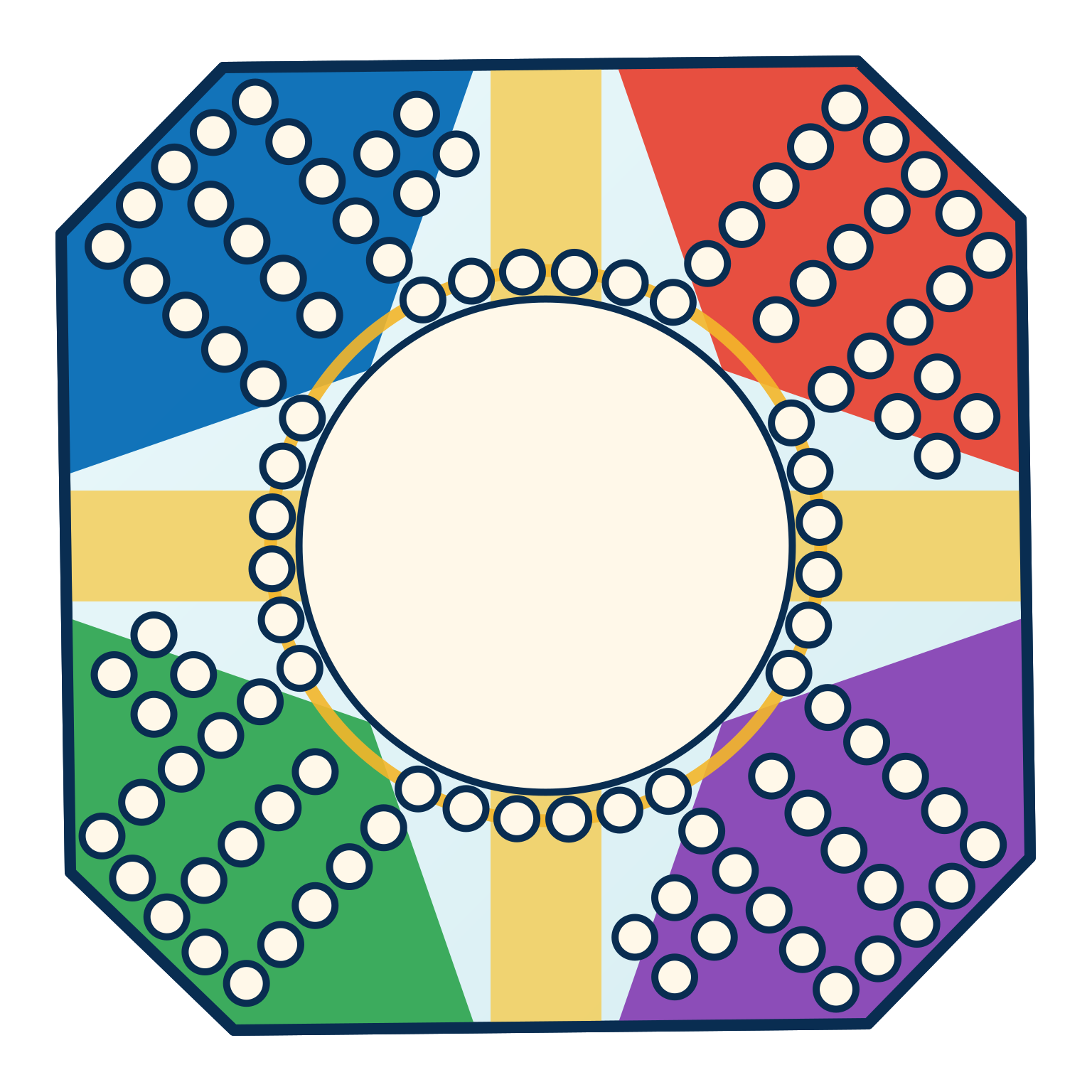
A loop of 76 holes, 19 per player, running around the center and four corner arms.
Each player has 4 base holes where their marbles wait before entering.
The track hole next to your base. It is protected only for its owner.
The track hole linked to your finish lane. One hole separates it from your start hole.
Four holes leading toward the center. A marble enters after a full lap and cannot continue around the loop.
03 · YOUR TURN
Play a card. Make it count.
Every turn follows the same rhythm.
01Choose one card
Play a card from your hand.
→
02Apply its effect
Move, swap, attack or use the card's special effect.
→
03Discard it
Place the played card in the discard pile.
No legal play?
Discard your whole hand and wait for the next deal. Example from the rulebook: if all your marbles are in base and your hand is 3, 6, 9 and 10, none can bring a marble out, so you discard all four cards.
04 · MOVEMENT
Know what you can cross.
Most cards move clockwise. The board's protected start holes and your own marbles create the real tactical constraints.
Clockwise by default
Marbles move clockwise around the track. The 4 is the only card that moves a marble backward.
Don't pass your own
You cannot pass your own marbles. You can pass friends' and opponents' marbles.
Landing sends it home
Landing on any marble sends it back to its base — even your own marble or a friend's.
Start holes are protected
A marble on its owner's start hole cannot be swapped, killed or crossed. For every other player, that hole is normal.
Can't bring out into your own start
You cannot bring a marble out if one of your own marbles is already on your start hole.
Opponent on your start?
You can still bring a marble out. It counts as landing on that opponent's marble, sending it back to base.
05 · FINISH LANE
Get home exactly.
After a full lap, a marble leaves the track at its entry hole and moves into its finish lane.
- The count must be exact. If the marble cannot reach a free finish-lane hole, it stays where it is.
- Finish-lane marbles are safe: they cannot be moved by the 4 or 5, swapped, killed or crossed.
- Your other marbles cannot jump over marbles already in the lane.
- The lane therefore fills from the far end first.
- Once all 4 of your marbles are in your finish lane, you play your teammate's marbles with your cards.
EXACT COUNT
4 safe spaces
4 safe spaces
06 · THE CARDS
Your deck is your toolbox.
There are 52 main cards: four copies each of A, 2–10, S, 12 and 13.
CARD DESIGN
See the cards before you play.
Every card uses the same Bisska visual language: bold navy outlines, cream stock, yellow/red accents and a clear action symbol.
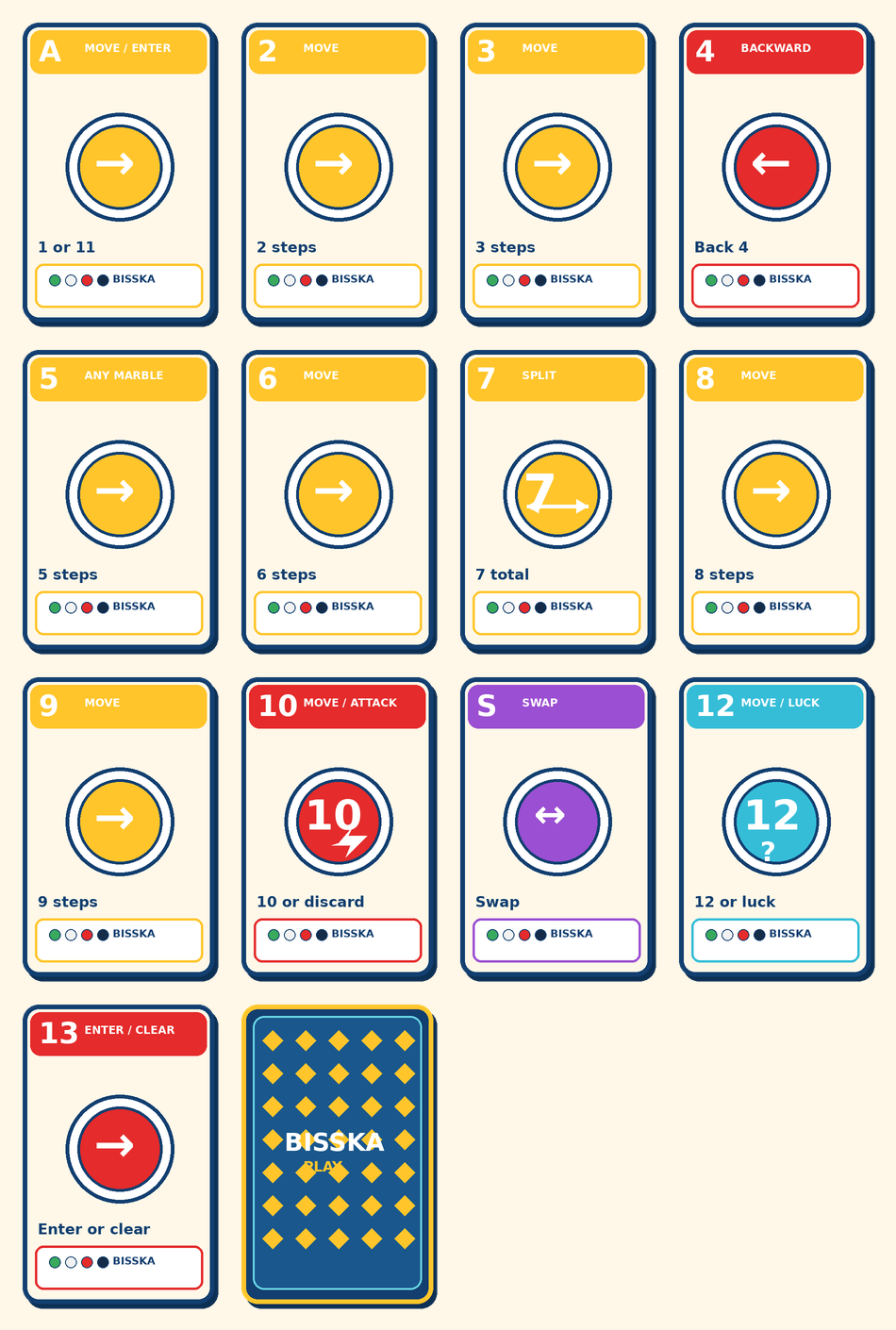
AMOVE / ENTER
1 or 11
Move 1 or 11 steps, or bring a marble out of your base onto your start hole.
2MOVE
2 steps
Move one marble 2 steps.
3MOVE
3 steps
Move one marble 3 steps.
4BACKWARD
Back 4
Move one marble 4 steps backward. It cannot move a marble in a finish lane.
5ANY MARBLE
5 steps
Move any marble 5 steps, even an opponent's or friend's. Not from an owner's start hole or a finish lane.
6MOVE
6 steps
Move one marble 6 steps. Landing on any marble sends it to base.
7SPLIT
7 total
Move one marble 7, or split the 7 between two marbles, such as 4+3 or 2+5. The total must be exactly 7.
8MOVE
8 steps
Move one marble 8 steps. Friends' and opponents' marbles can be passed; your own cannot.
9MOVE
9 steps
Move one marble 9 steps. If your own marble blocks the route, that move is not possible with it.
10MOVE / ATTACK
10 or discard
Move 10 steps, or make the next player discard one card without using it. Their turn ends. If they have no cards, you must move 10.
SSWAP
Swap
Swap one of your marbles with another player's. You cannot target an owner's protected start hole or a finish-lane marble.
12MOVE / LUCK
12 or draw luck
Move 12 steps, or draw a luck card. Play it immediately, then return it to the luck pile.
13ENTER / CLEAR
Enter or clear
Bring a marble onto your start hole, or move 13. Every marble crossed goes back to base. A protected start-hole marble cannot be crossed.
LUCK?BISSKA
12
KILL
07 · LUCK CARDS
Sometimes the luck changes.
There are always 8 luck cards: A, 4, 5, 7, 10, S, 13 and Kill.
When a 12 lets you draw one, play it immediately, then return it to the luck pile. The A, 4, 5, 7, 10, S and 13 work exactly like the main cards.
KillSend one of your own marbles on the track back to base. If you have none on the track, nothing happens.
🏆
08 · WINNING
Eight marbles. One team wins.
The first team to get all 8 of its marbles into the finish lanes wins the game.
09 · BISSKA CHALLENGE
What would you play?
You've learned the rules. Now prove you can use them. Read the situation, look at your hand, and choose the card that makes the legal move.
Think like a Bisska player.
Choose one card for each situation. Your score appears at the end, and every answer comes with a rule explanation.
Situation 1 / 10Score 0
YOUR TURN
💡
Which card should you play?
PULL UP A CHAIR
Your first match.
Bissa beside you.
Join Bissa, Green, Violette and Pirate at the table. Choose your cards, follow the marbles and learn each move as the story unfolds.
4 friendsGuided movesPlay at your pace
Come play with us →READY?